
Honey Fungus
- NPTC Qualified
- £10m Public Liability
- 20+ Years Experience
- Family Run Edinburgh Business
Managing Infected Stumps
If a stump is suspected to be infected with honey fungus, care should be taken when removing and disposing of the material.
When carrying out stump grinding on infected stumps, we recommend that the resulting woodchip is not reused in the garden. Instead, it should be removed and disposed of appropriately, such as via landfill or green waste facilities that accept contaminated material.
Signs of Honey Fungus
- Leaf drop during dry periods
- Early leaf fall in autumn
- Reduced or excessive flowering in spring
- White fungal growth beneath the bark at the base of the tree
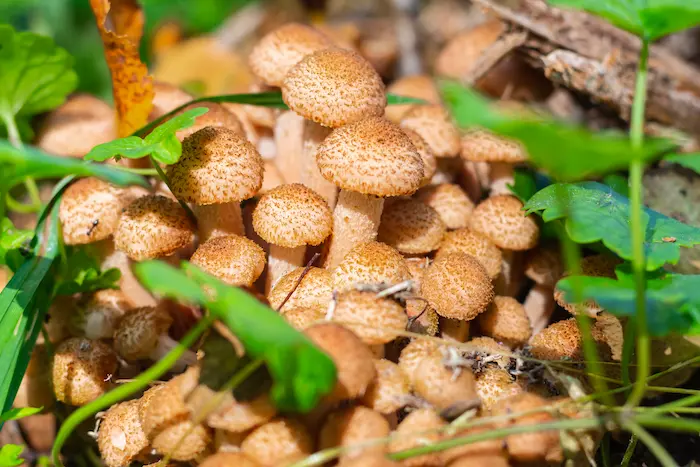
- Honey-coloured mushrooms appearing around the stump or root area
- These symptoms can vary depending on the species and stage of infection.
Preventing Spread
To help prevent the spread of honey fungus to nearby plants, the affected area can be isolated using a physical barrier.
This typically involves installing a vertical barrier made from rubber or heavy-duty plastic around the infected area:
Installed at least 450mm (approximately 1½ feet) below ground level
Extending slightly above ground level to prevent surface spread
This helps limit the movement of the fungus through the soil and root systems.
Frequently Asked Questions
A few common questions about stump grinding in Edinburgh.
How are tree stumps removed?
We use a professional stump grinding machine (sometimes called a root grinder), which breaks the stump down into wood chip. This is left in place and can be used as mulch, left to naturally rot into the soil, spread under hedges, or disposed of in your garden waste.
If you’d prefer everything removed from site, we can arrange that too.
For a more detailed breakdown of the process, see how to remove a tree stump.
How deep does stump grinding go?
Stumps are typically ground to a depth of between 15cm and 30cm below ground level. The exact depth depends on access, the size of machine we can get in, and the surrounding conditions.
In some situations, going deeper may not be practical or safe — full details are outlined in our terms and conditions.
Are stump grinding quotes free?
Yes. We offer a simple online quote system where you can send over the details of your stump, and we’ll get back to you with a price. All quotes are based on the accuracy of the information provided, so in some cases the final price may need adjusting once we see the job in person.
If needed, we can still arrange a site visit. You can get started via our contact page.
What happens to the wood chip?
The grinding process produces wood chip, which is usually left on site and backfilled into the hole. This helps level the ground and can improve soil structure over time.
If there’s excess material from larger stumps, it can be spread across beds, used as mulch, placed under hedges, or disposed of via your garden waste bin. If none of those options work, we can quote to remove it completely.
Can I plant over the old stump after grinding?
Yes, in most cases you can turf, seed, plant or fence directly over the area once the stump has been ground out. We’d usually recommend adding some topsoil or compost first.
If you’re planting a new tree, it’s often better to slightly offset the position rather than planting directly on top of the old stump.
Will the tree grow back after stump grinding?
In almost all cases, no. Stump grinding effectively kills the stump and is one of the most reliable ways of preventing regrowth.
If anything unexpected does come back, we’ll return and deal with it. For comparison with other methods, see how to kill tree stumps.
Do you remove all the roots?
No — we remove the main stump and the immediate surrounding area to a depth of at least 15cm, and up to 30cm where access allows.
Full root removal isn’t usually necessary and can be far more disruptive. If required, we can grind out visible surface roots. For more involved jobs, see tree root removal.
Can you get a stump grinder through a gate or tight space?
Yes! Access is rarely an issue. We have a range of machines designed to get through narrow gates, across steps, and into confined areas such as raised beds or enclosed gardens. For very large stumps, wider access may be required, but we’ll advise on that upfront.
Will underground services be affected?
Most underground services are buried deeper than the typical grinding depth of 15cm to 30cm. However, it’s important that you let us know about anything in the area beforehand.
Shallow services such as broadband or garden cabling are the most common issue, as these are often laid close to the surface.
How much does stump removal cost?
The cost depends on the size of the stump, how many there are, access for machinery, and your location.
Most customers are surprised at how affordable stump grinding is.
You can get a quick estimate using our online form, or read more about pricing here → cost of stump grinding.